
When the evil empire cast a shadow over the free world and nuclear annihilation was only a crisis away, what happened inside the White House stayed there. Until now.
American Portrait is a canvas stretched across the centuries, painted with the dark hues of Henry Kissinger’s realism and the bright strokes of Jimmy Carter’s idealism. The interplay of their tones creates a tapestry in which their philosophies collide and blend like colors meeting at twilight.
The frame, measuring 100 years in each direction, both anchors and magnifies the composition. Yet within its borders, the painting transcends chronology. It invites the viewer to linger, to see beyond contrasts and find the moments in which brushstrokes converge into something even more profound - a portrait not just of two individuals, but of a nation’s struggle for freedom.
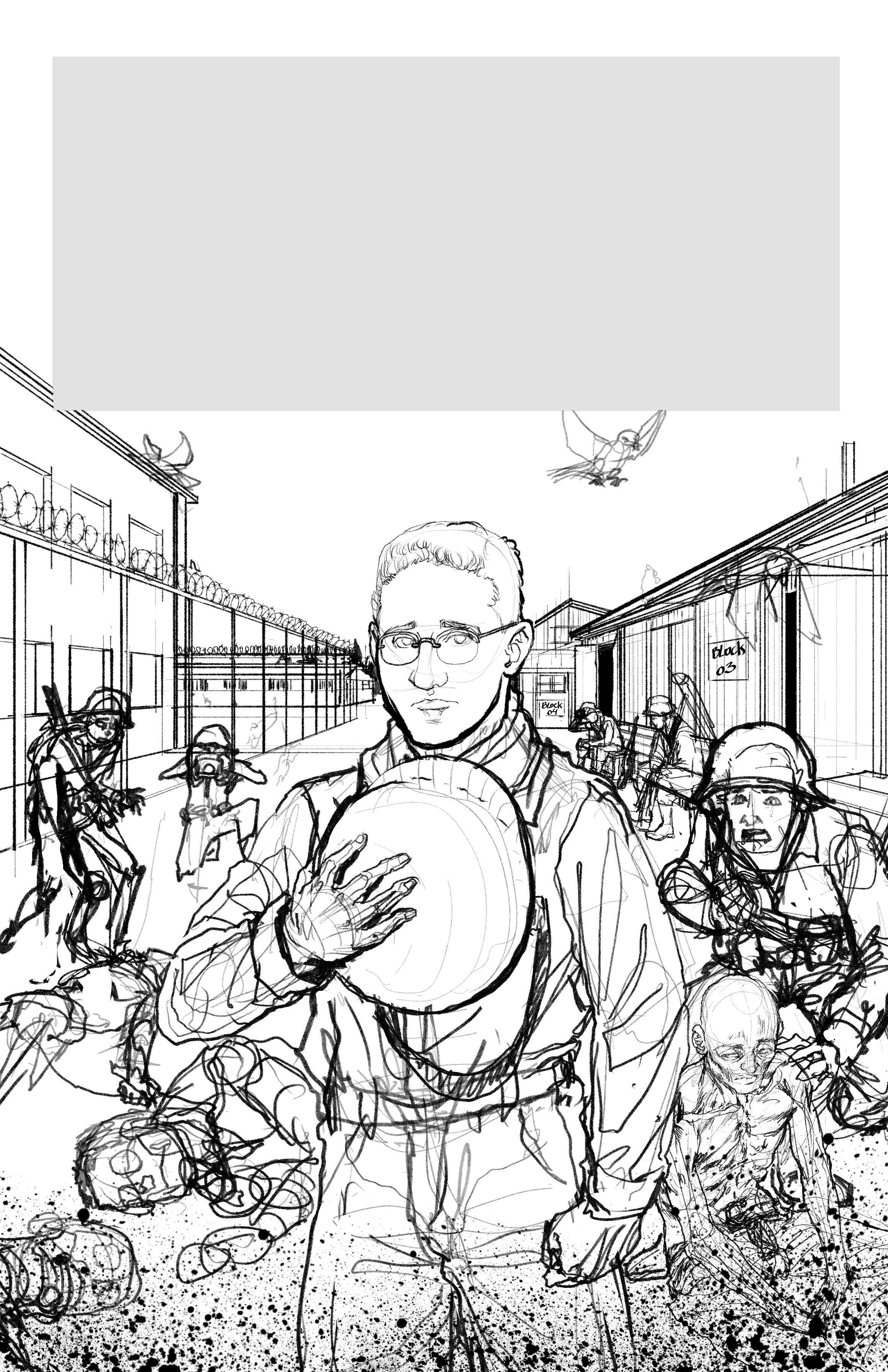
1923 - 2023
Kissinger: A World Destroyed will be released Fourth of July 2026.
Illustrator: Gustavo Melo

1924 - 2024
Carter: The Blood Beneath the Soil will be released Fourth of July 2028.
To paint a complete American Portrait, Simon Allmer is in the process of reviewing all of Henry Kissinger's published works since 1950.
To paint a complete American Portrait, Simon Allmer is in the process of reviewing all of Jimmy Carter's published works since 1975.
To light up the New York skyline, you must start at the ground floor.
What if the Cold War turns Hot?
More information coming soon
[Editorial Disclaimer: The following piece is a stylized review written from a historical perspective.]
November 1957
Whenever a new technology comes around, the imagination of the public usually ascribes to it characteristics of the familiar while the technologists of the era promise something unlike anything that came before.¹ Usually the public is correct.
An army from the War of the Spanish Succession from 1701 would have little problems understanding the weapons and tactics of an army from 1815 at the Battle of Waterloo. While the weapons became more sophisticated, the fundamental conduct of war didn’t change even after the Industrial Revolution. It is because of this slow evolution in combat that the world has difficulty coming to grasp with a true revolution: the atomic bomb.
Dr. Henry Kissinger’s second book Nuclear Weapons and Foreign Policy sketches out a framework that aims to turn the nuclear threat into a nuclear opportunity for American policymakers. While provocative, the arguments laid out are neither entirely new nor a singular effort by the author. Instead they are the result of a focus group at the Council of Foreign Relations of which large parts have appeared in their publications.²
What is novel however, is the depth of the argument; the fluidity with which Kissinger navigates technicalities of atomic warfare and the psychological aspects driving leaders and their population. Beyond the academic walls, the book is also making waves in the White House with Vice President Nixon seen carrying a copy and reaching out to the Harvard professor.
The issue at heart is the inflexibility of options that leads to paralysis. While the Soviets, now possessing nuclear parity, keep advancing in Eastern Europe, Arabia and Indochina, the only responses on the U.S. side would be a costly Limited Conventional War (as in Korea), an Unlimited Nuclear War (leading to the possible destruction of civilization) or inaction (resulting in further Soviet advances).
It is reasonable that the more powerful weapons have become, the greater is ones reluctance to use them. This fact is skilfully exploited by the Soviets who keep their conquests below the levels of agitation while promoting “peace campaigns” to stir up internal opposition. The American empiricist mind also cannot comprehend the radical transformations envisioned by communist doctrine. In this sense, the authors doctoral dissertation about 19th century European statecraft as well as his historical experience in World War II serves as a prologue. Whether Napoleon, Hitler or Stalin, their aim was never legitimacy in the current system but, true to revolutionary doctrine, an erosion of the entire system.
To solve these issues, Kissinger advocates for the option of Limited Nuclear War. What at first seems like an oxymoron should give the American side a proper response to Soviet aggression without resulting to Unlimited War. It should be thought of less like land warfare, in which the conquest of territory through large armies is the main goal, and more as a sea battle. Small self-contained units would unleash their great firepower for a fast destruction of enemy forces.
By reorganising the military command into a Tactical Force for Limited Nuclear War, a Strategic Force as a last deterrent, as well as through communicating ones objectives to the enemy, Kissinger believes that engagement, even with nuclear weapons does not escalate to the destruction of civilisation. In fact, compared to a Conventional War that slowly raises the stakes and might spiral out of control, the new framework would establish its limitations upfront. It is unclear however if these self imposed limitations apply to each party equally. The Soviets greater willingness to run risks and rejection of diplomatic obligations should not put the hopes too high.
In an analysis of handwritten notes, the Soviet thought becomes more clear. Lenin views war as “part of the whole” of politics in which “appearances are not reality”. Instead of being a last resort, wars are part of the communist struggle and should be conducted whenever the relation of forces is favourable. Khrushchevs adaption of peaceful coexistence can be aligned with the more belligerent Lenin who would often paraphrase Clausewitz: “The conqueror is always a lover of peace. He would like to enter territory unopposed.”
Against prevailing notions, the Gordian Knot of Nuclear Tension cannot be cut through by a symbolic world authority such as the United Nations. Its hand would still be made up of the two superpowers, making an effective slash nearly impossible. Although more hopeful in name, the World Peace Movement makes the author even more pessimistic as it represents a psychological warfare operation by the Soviets to hamstring Americans through their own preconceptions. While it is true that the World Peace Council³ is a direct Soviet operation with no intention of banning their own bomb, dismissing the entire, largely grassroots movement, instead of engaging with it is a lost opportunity if policies were to be made on a moral foundation.
The choice for Limited Nuclear War by Kissinger also comes from the American experience. Although it lacks the wisdom of a long history and currently celebrates the over specialised expert inside a dysfunctional bureaucracy, its great strength comes from self-reliance, spontaneity and initiative that no Soviet Military Academy could replicate. Because the key to survival in a Limited Nuclear War lies in a dispersal of units and of success in mobility Americans are psychologically equipped for it. The military manifestation of this individualism will be the flying platform, transporting single soldiers through the air.
The authors maxim that one should use the smallest amount of force consistent with achieving the objective is especially important when bringing the deadly capabilities of the new bombs to mind:
A 20 megaton thermonuclear bomb represents the same order of increase in explosive power over the atomic bomb exploded at Nagasaki as the Nagasaki bomb did over the largest blockbuster of World War II, that is, a thousand fold increase.⁴
The mutual terror resulting from this has the paradoxical effect of leading to an equilibrium in terms of national survival. It may however doom Non-aligned countries to a fate determined by the most ruthless player when peace is the Americans only objective and when no intermediary military options exist.
Kissinger views the punishment of Prometheus for stealing the fire from the gods as adequate because of the horrors it would unleash on humanity. Having stolen the fire, the job of the statesman now is to have a better foresight and initiative, that is make decisive decisions without full knowledge but with an awareness for the risks they entail. In that sense Prometheus serves as a role model for his foresight. A foolish path would be that of the titans brother Epimetheus. To wait for events to pass only to be knowledgable in hindsight with outside forces shaping the world. In either case, the box of Pandora has opened.
The authors historical references and unique arguments are more compelling than the style they are presented in. Same concepts are introduced countless times because the foundational articles, that assume new readership, are largely left unaltered.⁵ Nevertheless the importance of the subject matter and intellectual rigour of Kissinger and his associates⁶ makes for an engaging thesis. The critic, perhaps a member of the Eisenhower administration, will call the book a dangerous invitation to a “limited” atomic disaster, while the new school of strategic realists might counter with the necessity of flexible responses that links power to policy. Only the unfolding of this century will prove which of them has grasped the nature of the fire.
¹ Apart from genuine belief, this also serves the purpose of securing funding from academia or industry.
² The article Military Policy and Defense of the "Grey Areas” published in 1955 not only introduced the concept of Limited Nuclear War to readers but also launched Dr. Kissingers career as a public intellectual.
³ For those with a penchant for creative coverage, one might consult the information bureau of the World Peace Council.
⁴ Government official Paul Nitze critizised the book for miscalculating the blast effect of certain weapons, using “the cube root of their stepped-up explosive power” instead of “the square of the cube root” that is less destructive.
⁵ Even single phrases might tire the close reader. For example “To be sure” is used 92 times throughout the text.
⁶ Ranging from study group chairman Gordon Dean to outside expert Robert Oppenheimer, the “Father of the Atomic Bomb”.
December 2024
In Henry Kissinger's last book before his passing, written with technologists Eric Schmidt and Craig Mundie, the trio combines the statesman's mastery of applied history with the scientific knowledge necessary to envision the future. The rapid pace of disruption makes practical frameworks necessary to reap the benefits of AI without committing irreversible errors that could mean nothing less than the end of humanity.
Just three years ago, in 2021, when the first volume, The Age of AI, was published, Kissinger and Schmidt introduced the reader to then-obscure products like GPT-3. A lot has happened since the chatbot texted itself into the public consciousness. Some people already see an end to the AI hype, but the authors argue that we are still at the very beginning—the genesis of something truly transformational.
With an intellectual capacity surpassing any human polymath and future machine scientists acting autonomously, AI systems could bridge the gap between seemingly unrelated fields by finding the hidden truths of the universe. Connecting the social to the natural sciences, these discoveries are both promising and frightening to society. From curing diseases to unprecedented military threats, our world has never been more potent yet fragile. In order to evolve, "Homo Technicus" will have to live in symbiosis with machine technology, neither succumbing to fatalistic submission nor outright rejection.
By developing systems for distribution, participation, and education, the benefits of AI could be shared with the whole population. The authors imagine that in an abundant world, people will work for pleasure and pride instead of paychecks. In fact, the prevalence of machines could give new value to authentic, unassisted human achievements. But what about working with AI systems?
One such early experiment was Project Cybersyn by the socialist Chilean government from 1971–1973, employing a network of telex machines, software for monitoring factory performance, and an economic simulator to develop self-regulation of factories. Still relying on human operators to interpret the data and make decisions, it nevertheless shared many conceptual similarities with humanity's visions for AI.
That this project never came to fruition is partly Kissinger's fault, according to some. Fearing a pro-Marxist government, the then-Secretary of State supported efforts to provoke a military coup. After these failed and the new president, Salvador Allende, assumed office, the National Security Decision Memorandum 93, written by the author, suggested cutting off economic cooperation, almost incidentally creating the climate for an indigenous coup that was to follow.
It will only be a matter of time until AI systems are widely implemented in governmental processes. The authors warn of both over-restrictive policies, currently exemplified by the European Union¹. and irresponsible innovation that some Silicon Valley companies covertly envision. The former would withhold the great prosperity that could come to a wide population if redistributed correctly², while the latter leaves out the human element. What is left unwritten are the different incentives driving public and private actors. Even partnerships between profit-driven companies such as OpenAI and Microsoft might be doomed to fail in a "Winner Takes All" economy. Either way, successful revolutions in the past have been incremental and not everywhere all at once.
Proposals by an administrative division during the year of the French Revolution in 1789 are amusing in retrospect. In the name of progress and science, the country was split into 81 geometrically perfect squares³, resembling a chessboard. Not taking into account previous borders such as rivers and mountains or any cultural factors, it was rightfully rejected by the Assembly. Silicon Valley often supposes that its technical brilliance is applicable everywhere.
In the medium to long term, AI will be able to change not just the natural and social environment of humans but also our biology, possibly turning us into superhumans. Are we then to become pawns in the chess game of an unknown entity, divided by those who play by the rules and those who fall victim to them? Or should we resist this change and view machines as nothing more than inanimate objects akin to literary characters?
Assuming an AI can feel as much emotion as Hamlet—only existing in the abstract—it can nevertheless write its own story without Shakespeare. Kissinger compares this loss of human control to eighteenth-century European leaders unlocking the mechanical forces of self-interest. The enlightened absolutists from that era fit Plato’s philosopher-king vision, as a layer of idealism was added to Realpolitik. The early Islamic thinker Al-Farabi argues that it would be highly unlikely for one person to fulfill both philosopher and king roles; therefore, they must be split between two people. Aristotle goes further. His participation of the masses fits our modern understanding of statecraft. The question is which model, if any of the selection, is suitable for machines surpassing us in almost all cognitive tasks but acting on our behalf.
The organizational structure is also up for debate. Stable institutions are typically hierarchical and might be the most effective way to organize a low-trust society uncertain about the future. But while armies win wars, they are inherently uncreative. A network structure with the capacity for self-regulation and without central coordination lends itself better to the technologically driven innovation of the 21st century. Is the latter model of shared agency through different human and machine actors the most beneficial for society as a whole, or can shared power also corrupt absolutely? Schmidt notes that AI proliferation leads to centralization in the current model. Whether this is good or bad remains up for debate.
To prevent a misalignment of AI, it is crucial, the authors argue, to create a common doxa of human truths in addition to feeding it with formal laws⁴. The instilling of doxa is achieved through observation rather than articulation of human behavior. What is left open are the measurements AI systems would take if confronted with no written laws and conflicting unquestioned truths. Within a society, disagreements such as the Sunni-Shia divide offer no agreed-upon solution. Should the position of an AI at an international conference be equal to the distribution of the populations in question (that is, 90% Sunni and 10% Shia), or, when this is inherently contradictory, should it take a secular outside perspective which might enrage all parties?
Where the book has its shortcomings is in the assessment of human traits that make us different from AI and therefore worth protecting. The authors propose a Kantian concept of dignity as one of those pillars, in which mortal creatures “programmed” for survival can nevertheless act autonomously against their evil instincts. While acknowledging that this good versus bad judgment is subjective and that mentally handicapped people still deserve respect, it is hard to say if any of our choices are truly autonomous, and who makes that judgment.
This should not open the age-old debate about free will. Humans have a variety of options to choose from, but all of these might not be so unnatural.
Let us imagine a seemingly selfless act: a mother jumps in a turbulent river to save her infant son from drowning. Knowing the high risk of being submerged and killed herself, she manages to grab the boy and pushes him to the shore while succumbing to the water's forces. The natural instinct for self-preservation seems to have been overwritten by the human instinct for altruism.
But what if her intuitive calculation, made in a split second, was just as rational as her possible decision to refuse the self-sacrifice⁵? Depending on the scope, preserving life can mean preserving bloodlines but also nations (ideological warfare) or all of nature (environmentalism). The latter illustrates the ironic conclusion of people refusing to preserve bloodlines for the supposed greater good. Do these different conclusions have anything in common, and, if so, how can it be quantified to distinguish us from AIs?
From the general input “preserve life,” ingrained in our DNA, follows the benign addition “and reduce suffering,” which requires a complex pain awareness only found in mammals and birds⁶. Throughout history, great suffering has been inflicted because of different interpretations of the worthiness of certain life or because of rigid obedience. Pure sadism, an evolutionary dead end, is only rarely exhibited.
If we take Kissinger’s centennial life as a baseline for the average life expectancy of future generations, we can easily make comparisons between the value of life that, free from theological sanctity, offers a practical framework for biological and artificial decision-makers. When faced with the trolley problem, this system could add up the number of expected years remaining and save the group with the higher number. A corrupted system might add in factors such as creditworthiness or political affiliation.
While life and death is the purest binary distinction, decisions of that kind will fortunately remain rare in an era of abundance. Instead, smaller units of suffering that I would call discomforts will shape the day-to-day operations.
Bureaucracies that require citizens to fill out time-consuming and arbitrary forms when opening a business may be dissolved if no value is gained. Applied to policy which requires assessments without all information available, Kissinger’s doctoral dissertation, A World Restored from 1954, noted that bureaucracies’ quest for calculability leads to the decision-makers becoming prisoners of events. The disastrous choices during the first decade of US involvement in Vietnam illustrate this. However, I would argue that discomforts offering valuable learning experiences for the public or even delaying certain irreversible decisions for government officials could be nudged by a well-meaning system.
For qualitative assessment, I would recommend the introduction of Special Zones, operating with reduced or partially randomized laws to test out which incentives and restrictions work best for greater adaptation. Zones would also allow the free movement of citizens inside a geographic area with different belief sets. Religious individuals who see the modification of the human body as sinful, for example, could relocate to the nearest zone where this is outlawed instead of inciting violent uprisings.
The pace of change has accelerated. From taking thousands of years between the Stone, Bronze, and Iron Ages to taking 20 years from the Computer Age to the Networked Age⁷, major breakthroughs nowadays can happen in hours and even minutes. By segregating the innovations to Special Zones for beta testing and restricting the global distribution of transformative technology at first, societal confusion can be avoided and powerful applications withheld from malign actors.
Cyber attacks will reach a new level of danger once Artificial General Intelligence is available in the next 5 to 10 years, as such systems could find vulnerabilities invisible to the human eye. Bringing down the global financial system might be only one command away. Because of the devastating effects, it is unlikely that great powers will resort to such measures. The fact that the Cold War remained bloodless in the main theaters shows the ironic logic of mutually assured destruction. Schmidt therefore sees a threat not in antagonistic superpowers but in nihilistic terrorists.
I would recommend the implementation of trace marks embedded in the metadata so that if damage couldn’t be prevented, the individual or entity can be located by intelligence agencies. Every operation by the AI system would be logged in an immutable ledger that links the output with the responsible entity, timestamp, and method of generation. This would not only ensure accountability but also enable content verification and prevent misinformation. The intelligence agencies with access to the sensitive information must be democratically elected in a supranational body such as the United Nations in order to prevent abuse of power by authoritarian regimes.
Genesis is more than armchair philosophy. Its broad questions and awareness of the unknown unknowns make it a timeless guide, helping readers adjust their inner compass toward the promised land. Rather than attempting to predict every stone or bend in the path, it embraces the reality that the natural contours of the journey—like rivers to be crossed or mountains to be circumnavigated—may necessitate unexpected detours. It teaches us to navigate with purpose and adaptability, without being shackled by the illusion of total foresight.
The book ties in with Kissinger’s first thesis, The Meaning of History, written over 70 years ago but asking similar questions about how technology changes human perception. If the book wasn’t a collaborative effort with tech optimists Schmidt and Mundie, its "Hope and the Human Spirit" might have been replaced with "Despair and Loss of Humanity." Although the avid reader may guess who wrote what, it is nevertheless a cohesive work that benefits from each contributor.
¹ The EU AI Act requires, for example, that systems be able to explain what they do, which is currently impossible. Brexit could inadvertently give the UK an economic advantage.
² One solution proposed would be an AI patent system in which great profits can still be made, but the invention would go into the public domain after a certain number of years.
³ Each square was further divided into nine districts, with each district containing nine square cantons. Every Frenchman should be able to reach the departmental capital within a day by horse (assuming the geography allowed it).
⁴ The writer of this article is currently working on a Cultural Taxonomy to formalize all recursive human endeavors.
⁵ Opening yet another debate: In which situations is inaction an active choice with agency? Does it have to be conscious, or can it be intuitive and even subconscious? Literary critics of Bartleby, the Scrivener might have the answers.
⁶ The somatosensory and neural systems responsible for this are less developed in reptiles, amphibians, and fish and are almost nonexistent in most invertebrates (the octopus being an exception).
⁷ Starting in the early 1990s, this age is marked by the evolution of connectivity, data, and interactivity beyond mere computation. Better name suggestions, apart from Networked Age, can be sent to the author of this article.
[Editorial Disclaimer: The following piece is a stylized review written from a historical perspective.]
June 2023
The circumstances of history place each society into the contesting forces of the inherited past, forming its memory, and a vision for the future that can lead to evolution or destruction. Philosophers speak of a destiny, so powerful that no individual could possibly defy it. The six leaders described in Henry Kissingers new book transcend these limitations and prove that by willpower and strategy, the impossible can become a new reality.
Konrad Adenauer, Charles de Gaulle, Richard Nixon, Anwar Sadat, Lee Kuan Yew and Margaret Thatcher all experienced the "Second Thirty Years War" and played key roles in the transformation of their countries during the 20th century, creating a transformative Post War order. For the first time, aristocracy gave way to a merits based social structure which made their middle class background an asset rather than a liability. Although intellectual in nature, their religious upbringing (except for Lee) instilled in them secular values such as self-control and taking the long view that proved crucial on their journey.
Kissinger differentiates between two kinds of leadership styles: the statesman and the prophet. While the former tries to retain order and political structures, prophets want to overturn those. By having absolute standards and a clear vision based on truth instead of utility, great changes can be made. There is however the risk that an individual is reduced to a gear wheel in the grand machine of their vision. Combining both qualities and not risking a loss in momentum or absolute chaos is a balancing act.
Another difficulty lies in the decision making. The more data becomes available to a leader, the less margin of manoeuvre one has. Many big decisions have to be made quickly with insufficient knowledge of the outcome. Therefore a good leader also incorporates qualities of an artist, using intuition to sculpt a future with the materials at hand and absorbing life in all its complexity. Because statecraft is not a science, history might be the best teacher.
One of those historical leaders, Konrad Adenauer cautioned the author "never to confuse energy with strength." Having experienced Germanys intransigent rhetoric and military potential that provoked external coalitions to war, as well as the Weimar Republic impoverished by economic crises, made clear that the country was either too strong or too weak for the peace in Europe. With all dignity lost and in the least secure position in 1945, this mayor of Cologne set out to restore his crushed society.
Meanwhile in France, Charles De Gaulle emerged after having led the Free French movement against the occupiers and building a new republic that implied continuity. His commitment to the national interest often came at the cost of recognising foreign help and constantly shifting alliances. To everyones surprise, he resigned from the government after France was liberated, only to return twelve years later and "amputate" Algeria from his country. By creating a vision and implementing it in a calculating, statesman style, De Gaulle followed no one strategy, placing inspiration of his people over doctrine. The republican values of the revolution can still be seen in “Gaullist” french foreign policiy today. His aloof leadership style which often went against the advice of contemporaries made his death in 1970 even more symbolic when he played his last game of solitaire.
"At his best in crisis. Cool. Unflappable." is Richard Nixons self assessment, written in the third person and handed to Kissinger before a press briefing. It shows both his self-promotion and insecurity that would determine many of the decisions during the Cold War. Turning the bipolar conflict between east and west into a three dimensional one with the opening to China, the two communist giants would be closer to America than to each other. This way Nixon was able to exploit their adversities through the concept of linkage. To remain credibility on the world stage and prevent communism from spreading across South-East Asia, Nixons hardline approach on Vietnam draws controversy to this day. Paradoxically, his critics opposed the absence of US intervention in a faraway crisis when it came to the Pakistani War of 1971. It came out later however, that Nixon and Kissinger did get involved by supplying F-104 fighter jets and more weapons illegally to military dictator Yahya Khan of West Pakistan in what would cost 500,000 East Pakistanis their life. This was done because Khan served as the intermediary between the White House and Mao Zedong. When India got involved and help create the independent Bangladesh, Nixon became furious as his tapes reveal. Refering to the Indian Prime Minister Indira Gandhi as “the old bitch”, he said that what the country needed was a “mass starvation”. Recognising that attitude affected policy, the author admits that some conversations “did not reflect moral elevation”.
While most leaders had inherited their countries long spanning history, Lee Kuan Yew started with a blank space that was to become the modern Singapore. Tension between three ethnic groups threatened the very future of this once British port ridden by corruption and tuberculoses during the late 1940s. Free voting was not an option as he feared, demographic divisions would express themselves in identity politics like democratic Sri Lanka where one majority suppressed the weaker party. Instead of just surviving he envisioned a flourishing city state based on excellence for its people. By making english the official language and manufacturing more efficient, Singapore transformed in one generation to become one of the wealthiest countries attracting multinational companies and scoring high in education. Lee improvised constantly by borrowing ideas from around the world to see if they worked on the island, as well as by locking up opponents without trial as he later remarked. The man who once narrowly avoided death by Japanese troops, invented Singapore's nature from his vision of the future and, by being respected on both sides of the Pacific assumed the unofficial role of "world conscience" in later years.
At the age of 100, Kissinger had the opportunity to meet all leaders described at the height of their power thereby giving the reader a more personal recollection of events than most history books would allow. In the case of Margaret Thatcher this is especially revealing.
By acting as if her country was equal to the US, the White House suspended disbelief even though Britains natural resources, economic performance and military, which was deployed during the Falkland War, were far from superpower status. While being forceful in public, the fact that she wrote handwritten letters to all families of fallen soldiers of said conflict gives her a more human and less iron dimension. The historical scope of the author also allows for observations that are more remarkable when viewed retrospectively. Such as her warning of the dangers of climate change in 1988, the foundations she lay for Hong Kong’s return to China in 1997 and the perilous issue of Europe that cost three more Conservative leaders (lastly Theresa May in 2019) their premierships. Speaking at the College of Europe about the continents future, Thatcher said that if they believed what is said about her, "it must seem [...] like inviting Genghis Khan to speak on the virtues of peaceful coexistence."
As the world changed from aristocracy to meritocracy we would expect more great leaders to emerge in the 21st century. The fact that this is not the case can be attributed to various factors. Driven by technology, the visual culture discourages deep literacy and reflection. Lee Kuan Yew observed in 2000 that "Winning an election becomes in large measure, a contest in packaging and advertising." Instead of leaders, todays "influencers" promote immediacy, intensity, polarity and conformity. The intellectual elite disregards their obligations to society in place of self-expression. But never has there been a time when guidance was more urgent and complacency more dangerous which is why tomorrows leaders (who hopefully show more regard for human life than the author) shall reveal themselves.
[Editorial Disclaimer: The following piece is a stylized review written from a historical perspective.]
November 2022
In the current discourse, the subject of AI is often discussed separately from other issues in technical terms. However the epoch-making transformations range from education, manufacturing, politics and art to nearly any other human endeavour. The rising popularity of AI with new startups being launched on a daily basis still leaves the question on the implications for humanity and reality itself. It is up to each individual or in case of this book, to a Secretary of State, a former Google CEO and an MIT researcher, to create a roadmap on what our future will look like and how we can shape it.
Throughout history humanity has understood itself as reasoning beings with a desire to understand the world. Questions that couldn't be answered were left to god or future generations. Even technological changes like the replacement of horses with cars or muskets with rifles left the social structure and military paradigm largely unaltered. The search for knowledge that the Enlightenment emphasised placed the rational mind as our defining ability and claim to historical centrality. But what if the machines surpass us in our abilities? Descartes "I think, therefore I am" could loose its legitimacy. Because: "If AI thinks, who are we?"
As humans began to approach the limits of their cognitive abilities and handed over tasks to machines powered by AI, so did their thoughts change, becoming less contextual and less conceptual. The internet is a provider of information. But information in itself is not meaningful. It must be understood through the lenses of culture and history. According to Kissinger, when information becomes contextualised, it becomes knowledge. When knowledge compels convictions, it becomes wisdom.
With little patience for wisdom the concept of intelligence was changed. Going back to the Turing Test of the 1950s, computer scientist John McCarthy defined AI as "machines that can perform tasks that are characteristic of human intelligence." For the last 50 years this would remain a concept. Even computers operated on the basis of precisely defined code which made them rigid. In the last years however, some major breakthroughs have occurred.
One example is AlphaZero. Whereas previous chess programs have relied on human expertise being coded into their programming, AlphaZero developed its skills by itself. Playing millions of games against itself to discover the underlying patterns of chess, the AI was able to beat almost any other program or human player using unintuitive methods like sacrificing the Queen.*
Compared to chess the pharmaceutical field is very complex. A "game" with thousands of pieces, hundreds of victory conditions and rules that are not fully understood, an AI was able to produce a new antibiotic called Halicin by identifying relationships between molecules that defied human description. Surpassing the Turing Test, Halicin is opening a new aspect to reality that we may never detect.
AI is not limited to solving specific problems like winning at chess or developing new antibiotics. Generative models like GPT-3 (generative pre-trained transformer) introduced just months after Halicin by OpenAI, is able to produce human like text on any subject in the form of an essay or a possible conversation. This makes it widely applicable yet difficult to evaluate and raises general questions about the uniqueness of our creativity.
The next frontier, envisioned by scientists is the development of AGI, artificial general intelligence. By combining traditional AIs (that have been trained narrowly) the goal is to develop a broader base of expertise. AGI should be able to complete any intellectual task that humans are capable of. Developing this super intelligence would require massive computational power and expenses with current technology being on the order of billions. Yet once finished, AGI would run on any smartphone and spread rapidly.
Wether AGI will be achieved in the next 5 years, 50 years or never, the effects of todays "primitive" AI through global network platforms like Twitter or Instagram are profound. By filtering what is important, machine learning algorithms also filter what is true. Conducting broad aspects of national, economic and social life on these platforms, the drive to serve users by providing entertainment might be replaced with the national interest of rival countries.
Those relationships are especially difficult to predict as so called lethal autonomous weapons systems are trained and authorised to select their own targets and attack without human authorisation. Using the same principles that enabled AlphaZeros victory, AI-piloted fighter jets can already dominate human pilots in simulated dogfights. Because of the uncertainty of the AIs perception, the strategic effects of these weapon may only be proved through use.
The authors put technologies into three categories: technological differentiation (civilian or military), concentrated control and magnitude of effect. Some technologies have multiply qualities. Railroads can deliver goods to the market (civilian) and soldiers to the battle (military). However they have no destructive potential. Nuclear technologies are dual-use and possess great destructive effects but because of the complicated infrastructure they are in secure control of the government (in contrast to the widespread but not as destructive hunting rifle). For the first time in history, AI breaks this paradigm.
Being dual-use, easily spread with a few lines of code and having great destructive potential an unprecedented strategic and technological challenge arises. The authors urge leaders to start a dialogue and maximise decision time during extreme situations, to seek national advantage with an ethic of human preservation. Though the advancement of AI is inevitable, its ultimate destination is not.
*One might view the victory of AlphaZero not just as a testament to the superiority of AI but also as a new way in looking at the perfection of a craft. Maybe intuition is misleading and collectivism restricting. If seen from a different angle, AI could reinforce the humanist ideal of the individual and, ironically be a warning against the interconnectedness of modern technology.